
From Lab to Impact: Rethinking Energy Storage
When Hamood Qureshi chose LSU, he was chasing more than a degree. A Lafayette native who grew up passionate about chemistry and math, he wanted to use his education to address real-world problems in Louisiana, especially securing the environment and communities along the Mississippi River.
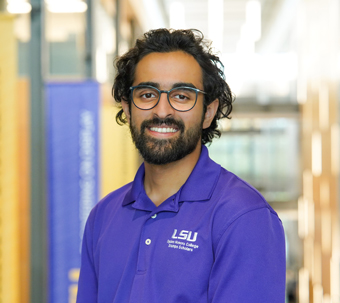 As a sophomore, Qureshi — who holds the Gerard Family Undergraduate Scholarship in
Chemical Engineering, the Dr. Ben H. Thibodeaux and Clare Roy Thibodeaux Scholarship,
and a Stamps Scholarship — joined an LSU research project led by College of Engineering’s
Dr. Kevin McPeak that used lasers to create nanoparticles capable of storing and releasing
hydrogen.
As a sophomore, Qureshi — who holds the Gerard Family Undergraduate Scholarship in
Chemical Engineering, the Dr. Ben H. Thibodeaux and Clare Roy Thibodeaux Scholarship,
and a Stamps Scholarship — joined an LSU research project led by College of Engineering’s
Dr. Kevin McPeak that used lasers to create nanoparticles capable of storing and releasing
hydrogen.
Led by Dr. Kevin McPeak in the College of Engineering, the project positioned Qureshi at the intersection of chemistry and engineering. He explored how these particles could store and release fuel in a controlled way, offering innovative approaches to supporting Louisiana’s energy needs and advancing cleaner, more efficient energy solutions. What began as a campus project quickly became a launching pad for Qureshi, now a graduating senior.
“Being able to work on these problems that affect Louisiana and to do it here at LSU has been incredible,” Qureshi said. “I wouldn’t have believed four years ago that I’d be doing the research I am today.”
That work opened the door to a competitive summer placement at MIT, where Qureshi pushed further into renewable energy. His research there focused on carbon capture and biofuel generation using microbes, expanding his perspective on how chemistry and engineering can be harnessed to reduce greenhouse gas emissions and create sustainable energy sources.
Internships have added another layer to his growth. At Marathon Petroleum in Garyville, La., he applied what he had learned in the lab to optimize real-world operations. The work confirmed for him how vital engineers are in shaping not only the future of energy but also the day-to-day safety and efficiency of industry.
“It showed me that chemical engineers have a lot of power to make an impact,” he said. “My degree and my education are going to be very useful for solving challenges moving forward.”
Scholarships have been the constant thread through every step.
“My school has been covered through my scholarships,” Qureshi said. “It’s allowed me to really focus my time on pursuing opportunities that would help me become who I want to be, rather than trying to find opportunities that would pay me well. Because of my scholarships, I was able to find who I am and figure out how I can make an impact on my community, my state, and my country.”
Looking ahead, Qureshi plans to apply for prestigious fellowships such as the Fulbright. He has set a goal of pursuing a doctoral degree in chemical engineering and becoming a professor, determined to continue finding energy solutions while mentoring the next generation.
He said he knows those goals are possible because of the generosity of donors. “[Their] generosity is having an impact on the next generation of engineers, and [they’re] empowering students to go out and chase opportunities where they can have impact.”