
A New Era of Discovery at LSU
Brant Faircloth, the Moreland Family Distinguished Professor in the College of Science, has always been fascinated by the hidden connections in the natural world. As a faculty member in the LSU Department of Biological Sciences, he studies the evolutionary history of vertebrate animals, like birds and reptiles, piecing together how species are related. His research not only expands knowledge of biodiversity but also prepares students to work at the cutting edge of modern science.
Faircloth’s work is deeply collaborative, blending biology, genetics, computation, and fieldwork.
“We spend a lot of time collecting specimens,” he said. “We also spend a lot of time sequencing DNA from those specimens and using computational tools to try to understand the relationships among those organisms.”
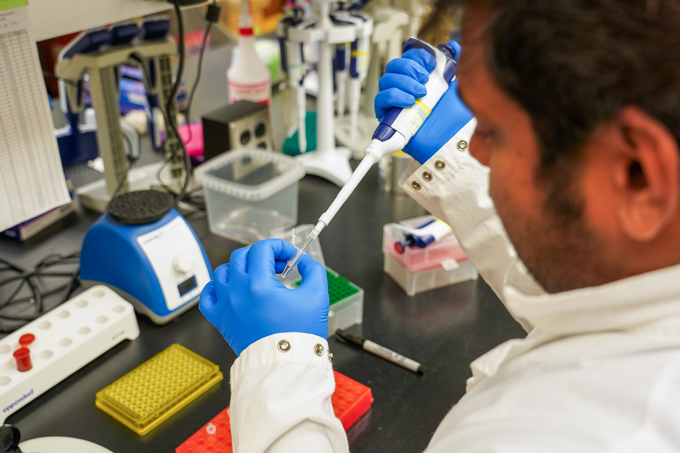 This work not only answers fundamental questions about life on Earth but also gives
students hands-on opportunities at the forefront of discovery. Now, on the cusp of
the opening of the Our Lady of the Lake Health Interdisciplinary Science Building,
Faircloth sees a new chapter unfolding. “Having a building that is designed around
interdisciplinary science is going to have a really big impact on our research,” he
said. “The thing that really excites me is having a physical space where people from
different areas of biology and, frankly, different areas of science in general are
going to run into one another.”
This work not only answers fundamental questions about life on Earth but also gives
students hands-on opportunities at the forefront of discovery. Now, on the cusp of
the opening of the Our Lady of the Lake Health Interdisciplinary Science Building,
Faircloth sees a new chapter unfolding. “Having a building that is designed around
interdisciplinary science is going to have a really big impact on our research,” he
said. “The thing that really excites me is having a physical space where people from
different areas of biology and, frankly, different areas of science in general are
going to run into one another.”
The design of the building creates chances for collaboration that can’t happen in isolation. “It’s hard to create those kinds of random interactions when you’re not physically located in the same space,” he explained. “So just the design of the building, the ability for people to interact across disciplines, is going to have a really big effect.”
For students, the building promises more than upgraded classrooms and laboratories. It offers an education that mirrors the way science is practiced today — team-based, interdisciplinary, and data-driven.
In Faircloth’s lab, students learn to think like biologists while also developing computational and analytical skills that position them for success in a wide range of careers. Being immersed in a modern facility reinforces that training, preparing graduates to lead wherever they go.
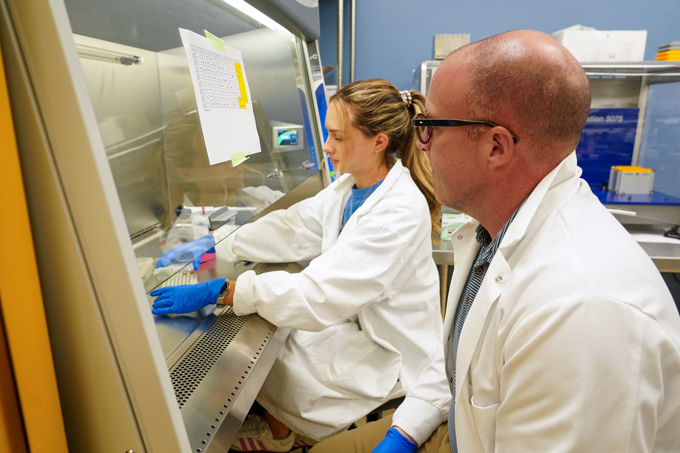 For Faircloth, the investment in infrastructure is also an investment in the future
of LSU and the state of Louisiana. “What’s exciting to me is the impact on our ability
to recruit new faculty and new students,” he shared.
For Faircloth, the investment in infrastructure is also an investment in the future
of LSU and the state of Louisiana. “What’s exciting to me is the impact on our ability
to recruit new faculty and new students,” he shared.
“It’s one thing to show them the great work we’re already doing, but when they see the physical manifestation of LSU’s commitment to science and to interdisciplinary research in this new building, that’s going to make a really big difference.”
That difference, he believes, will ripple far beyond campus. “The research that we do at LSU is not just important to the university. It’s important to the state. It’s important to the country, and it’s important to the world. Understanding biodiversity and the evolutionary history of organisms helps us make better decisions about conservation, about medicine, about human health. These are big questions that require big teams and big ideas.”
The Our Lady of the Lake Health Interdisciplinary Science Building, made possible through donor and state support, is helping make those big ideas possible. “Having donors invest in a facility like this is really critical,” Faircloth said. “It’s hard to do science without the physical infrastructure that supports it. So having donors that are willing to step up and say, we value science, we value interdisciplinary collaboration, and we want to make that happen at LSU, that’s an incredible gift.”
He doesn’t take that gift lightly. “It’s going to impact not only my research but also the training of students, the ability for LSU to attract new faculty, and the ability for LSU to make an impact in the scientific world. That’s a tremendous legacy for any donor to be a part of.”