
Engineering the Future of Construction
On most college campuses, construction zones are places to avoid. At LSU, they are becoming classrooms. When crews began work on the Our Lady of the Lake Health Interdisciplinary Science Building, faculty in the College of Engineering’s Bert S. Turner Department of Construction Management saw more than a fenced-off site. They saw an opportunity to shape the future of their field.
Guided by Chao Wang (Eddie Rispone Endowed Professor) and Amir Jafari (Buquet & LeBlanc Professor in Construction Management), students recently deployed SPOT and Pepper — robotic dogs equipped with 360-degree cameras — onto the active construction site. The project, supported by philanthropy, created a unique opportunity to experiment with cutting-edge robotics in a dynamic, real-world environment. This was meaningful not just for the faculty, but also for the students. Together, they took the robots out of the lab and into the complicated, fluid conditions of an active job site.
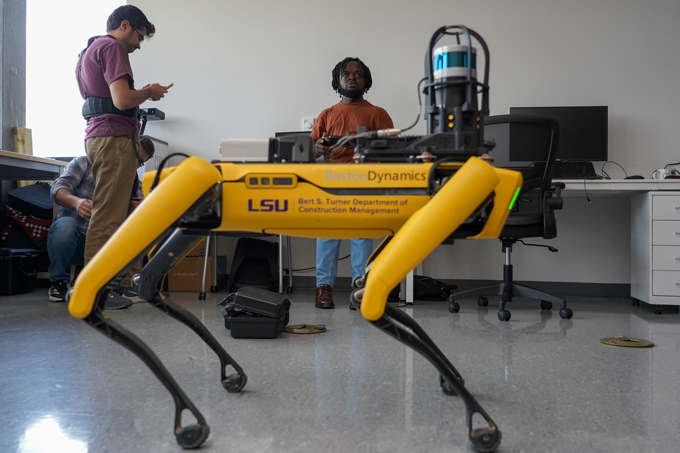 Wang’s work zeroes in on the data. Construction sites change by the hour, and even
the smallest movement can create ripple effects in safety, efficiency, and progress.
By programming SPOT to monitor activity across the building’s site, Wang and his students
were able to explore how autonomous robotics can gather real-time, reliable information
to inform decision-making.
Wang’s work zeroes in on the data. Construction sites change by the hour, and even
the smallest movement can create ripple effects in safety, efficiency, and progress.
By programming SPOT to monitor activity across the building’s site, Wang and his students
were able to explore how autonomous robotics can gather real-time, reliable information
to inform decision-making.
His team collected thousands of images and environmental data points from the active construction zones — stairs, scaffolding, cranes, and uneven terrain — and then labeled and categorized them into equipment, human activity, and safe-versus-unsafe terrain. That information is used to train robotic systems to adapt to unpredictable, ever-changing environments, helping them function as valuable assistants on job sites.
“Every project is different,” Wang said. “So you have to make sure whatever technologies you’re using can adapt to the environment and actually help the workers. That’s what excites me — figuring out how robotics can make construction safer and more efficient without removing people from the process.”
For Jafari, the question is not just what robots can do, but also how humans will adapt to working alongside them. His research explores the nuances of the human-robot relationship, investigating how people perceive, interact with, and ultimately trust autonomous systems in complex work environments. It’s all with the end goal of training workers more effectively and efficiently.
 “When the robotics come, the nature of construction work might change, but there will
always be a need for humans,” Jafari said. “I believe the type of research that we
do, seeing this vision, will help us be ready for that future to come.”
“When the robotics come, the nature of construction work might change, but there will
always be a need for humans,” Jafari said. “I believe the type of research that we
do, seeing this vision, will help us be ready for that future to come.”
Together, Wang and Jafari’s complementary approaches highlight the dual nature of robotics in construction. The technology must be advanced enough to provide meaningful data and adaptable enough to work in environments designed for humans. By engaging students in both perspectives, LSU is preparing future leaders who understand both the mechanics of robotics and the practical and ethical dimensions of integrating them into the workplace.
The Interdisciplinary Science Building provided the perfect setting. Its active construction environment gave students and faculty an unpredictable, real-world laboratory where they could test ideas that go beyond classroom simulations.
“There are a lot of things you cannot learn from a textbook, but you learn from real life. This was like a field trip. You can see how the building is built, how the building is supposed to be built, being exposed to it all [is invaluable],” said Wang.
The impact extends beyond campus. Construction is a cornerstone industry, and the innovations being tested at LSU could one day change how projects are managed worldwide. By advancing autonomous robotics while also studying human interaction with technology, LSU researchers are addressing some of the industry’s most pressing questions.
Both professors also agree that this work is also helping LSU attract new talent — students eager to work with cutting-edge technology and faculty eager to join a university that values interdisciplinary innovation.
“When donors support faculty, they really invest in the future of the city and nation, as we are educating the future workforce,” Jafari said.