
Theorizing the Next 100 Years
For generations, scientific discovery has often followed a familiar pattern: A breakthrough is made, published, and tucked into academic journals, only to find a practical application decades later. LSU mathematician Scott Baldridge believes that model is no longer good enough.
As the Loretta Cox Stuckey & Dr. James G. Traynham Distinguished Professor and a leader in LSU’s Theoretical Institute for Advanced Mathematics & Science, Baldridge is part of positioning LSU at the forefront of a new approach to research, one designed to accelerate discovery, break down academic silos, and strengthen the university’s rise among the nation’s elite institutions.
The institute, housed within the new Our Lady of the Lake Health Interdisciplinary Science Building, serves as a hub where mathematicians, chemists, physicists, biologists, and other researchers work side by side to solve problems that could shape the next century.
“The institute, in a nutshell, is the attempt to bring mathematics and other scientists together in the same room to solve the next 100 years of problems,” Baldridge explained.
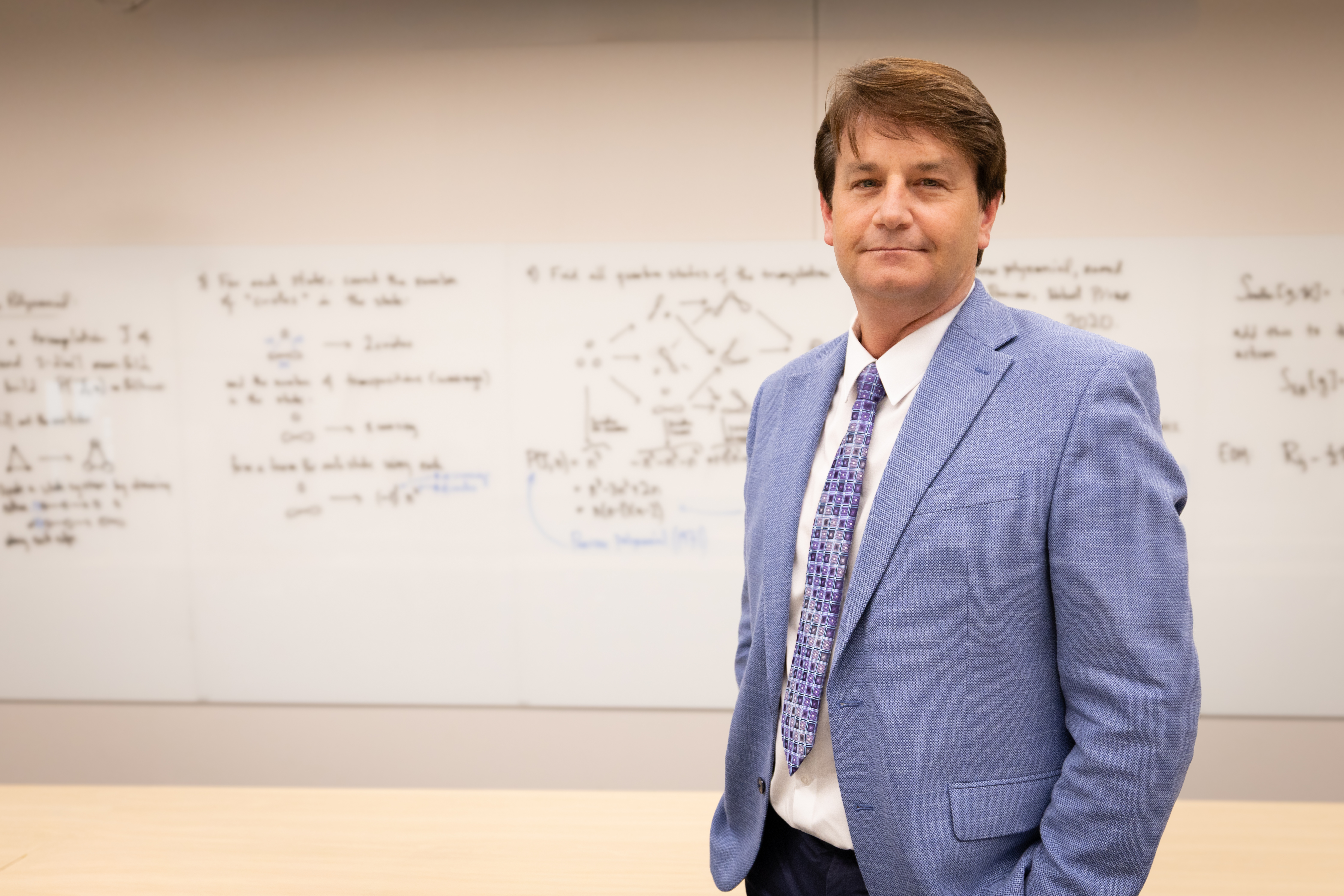
“The questions aren’t going to go away. They’re going to get harder, and fortunately we have new technology to help us solve those problems.”
For Baldridge, that mission is rooted in a challenge that has existed throughout the history of science. Mathematical theories capable of transforming entire industries often take decades to reach the people who need them most. He points to discoveries that ultimately enabled modern imaging technology and internet-era data compression, advances that emerged only after generations of waiting for connections to be made between disciplines.
“The whole point of this institute is to condense those three-generation periods between the creation of the model and the use down into five years,” he said. “Bring the scientists here, bring the mathematicians here, put them in the same room, have them work on the same problem, and build those solutions.”
That vision aligns directly with LSU’s pursuit of national research prominence.
“The institute has a chance to capitalize on our push for being in the top 50,” Baldridge said. “And you don’t get into the top 50 by having a bunch of departments that are 49.5. You need departments that are in the top 10, the top 20, to help pull everybody else into the top 50.”
Designed from the earliest days of the building’s planning process, the institute reflects a commitment to creating spaces where collaboration happens naturally. Researchers who once worked primarily within their own disciplines now encounter one another daily, sharing ideas and identifying opportunities that might never have emerged otherwise.
Baldridge sees Louisiana entering a new era defined by advanced industries, emerging technologies and increasingly complex scientific challenges. Theoretical research will play a critical role in addressing questions ranging from energy production and materials science to computing and space exploration.
“These are all very high-end problems,” he said. “They're going to require talented people from all across the world to help solve them.”
Just as important, the institute provides opportunities for students to interact with those problem-solvers firsthand. One of Baldridge’s strongest motivations is creating transformative moments for young scientists, mathematicians and researchers, moments similar to those that shaped his own career. As a graduate student, he had the opportunity to spend time connecting with renowned mathematician Sir Michael Atiyah, an experience that reinforced his decision to dedicate his life to mathematical research.
“That was what solidified it,” Baldridge said. “It was at that moment. It’s the kind of moment I want to give to our young people.” He added, “One of the things about this institute is bringing those types of caliber-level people here and having our undergrads and our graduate students walking across campus to get a cup of coffee with the Einsteins of today.”
Those opportunities are made possible through philanthropy. Endowed professorships, institute funding and investments in research infrastructure create the freedom to pursue bold ideas, attract exceptional scholars, and provide meaningful experiences for students.
Reflecting on the impact of his own distinguished professorship, Baldridge said the support has allowed him to focus more deeply on mentoring the next generation of researchers.
“Mostly what it gives me is time,” he said. “I’ve got seven grad students, and I worry about how to give them the time they need.”
That investment in people, space, and discovery is helping LSU build momentum toward national recognition while preparing future generations to tackle challenges that have yet to emerge.
“The questions aren’t going to go away,” Baldridge said. “They’re going to get harder, and fortunately we have new technology to help us solve those problems.”