
Access Beyond the Classroom
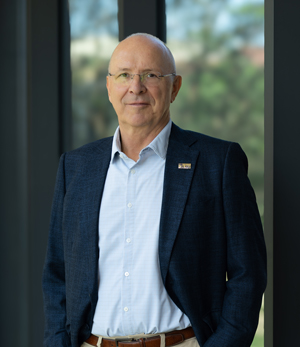
When Edward Watson, chair of LSU’s Stephenson Department of Entrepreneurship & Information Systems, talks about student success, he rarely starts with himself. He talks about the successful entrepreneur welcoming university students to network. He talks about recruiters sharing candid advice about company culture. He talks about students earning industry certifications that give them an edge in the job market. He talks about graduates who discover opportunities they never imagined were within reach.
For more than three decades at LSU, the E. J. Ourso College of Business professor has watched business education evolve. Technology has changed. Industries have transformed. Student expectations have shifted. But one thing has remained constant: Meaningful learning happens when students can connect classroom lessons to real-world experiences.
“To see the transition that students go through from when they go into the MBA program to when they come out — the way they think and the opportunities they see — is very different,” Watson said. “We do so much more outside of the classroom that helps engage students, helps them learn more and get involved in different activities that we couldn’t before. It makes the learning more realistic.”
Watson holds several professorships, including the E. J. Ourso Professorship in Information Systems & Decision Sciences; the Dr. Robert T. “Bob” Justis/T.J. Moran Distinguished Professorship; the James Curtis, Jr. Professorship in Entrepreneurial Management; the James C. & Cherie H. Flores University Professorship of MBA Studies; and the Donald Lindley & Ruby Phillips Developing Scholar Professorship.
“We do so much more outside of the classroom that helps engage students, helps them learn more and get involved in different activities that we couldn’t before. It makes the learning more realistic.”
The support provided through those endowed funds continuously creates experiences that expand what students can access during their time at LSU. For example, Watson uses professorship funding to provide simulations created by Harvard Business School that allow students to manage supply chains, develop products, and solve management challenges in realistic environments.
Endowed support has also afforded him the opportunity to assist junior faculty in attending conferences, pursuing professional development, and remaining connected to the latest ideas in their disciplines. Those investments ultimately benefit students by ensuring they learn from faculty who are engaged with emerging research, technologies, and industry trends.
 Donor support has also supported Watson’s efforts in bringing in industry members
directly to campus. Through programs such as CIO Hot Topics, business leaders and
technology executives share insights that students often cannot find in a textbook.
Recruiters discuss workforce needs, professionals describe challenges facing their
industries, and students gain exposure to career possibilities before they graduate.
For entrepreneurship students, those connections frequently happen in person.
Through LSU’s LEAP program and other experiential initiatives, Watson often takes LSU students across the state to meet founders, business owners, and innovators. They tour facilities and engage directly with the people building companies and creating jobs across the state.
“We get students in a van and drive around Louisiana,” Watson said. “It’s an amazing experience. Getting students out of the textbook and into the field, and engaging them in creative ways, has been shown to improve their learning, make it more enjoyable, and help them retain more.”
Such opportunities require resources. Transportation, programming, guest speakers, internships, certifications, faculty support, and student experiences all depend on philanthropic investment. Watson was quick to point out that many of the college’s signature programs would look very different without donor support.
“We can’t compete as a top university without the support of our donors,” he said. “We can’t do anything outside of offering courses without investments donors have made, and we do think of them as investments. We don’t think of them as donations.
“Thinking of it as an investment, you’re being more accountable for how the dollars are being spent, and you also feel a bit of sense of pride for being able to do something that is appealing to the investor. That only opens a door for potential investments in the future.”